Choosing a forklift supplier is only part of a successful material-handling strategy. Global buyers also need dependable Forklift Service after delivery. A reliable provider should support inspections, preventive maintenance, emergency repairs, operator training, spare parts, and warranty coordination. These services matter when a forklift stops beside a loading dock at 6 a.m.
Industry consultant John Faulkner describes the principle clearly: “A forklift is only as reliable as the service supporting it.” The statement is simple, but often overlooked. A low purchase price cannot compensate for delayed technicians, unavailable batteries, or missing mast-chain parts. Service quality becomes especially important in cold warehouses, busy ports, and multi-shift factories.
This guide examines China’s top 10 forklift service providers for global buyers. It considers technician coverage, response times, parts availability, remote diagnostics, maintenance planning, and international communication. It also reviews practical details, such as whether a provider can support mixed fleets and provide clear maintenance records.
No ranking is perfect. Service performance can vary between cities, dealers, and equipment models. A strong national network may still provide weak local support. Buyers should verify references, contract terms, training standards, and after-sales promises before signing.
The best provider is not always the largest one. It is the partner that answers quickly, explains failures honestly, and keeps equipment working safely. That difference may seem small—until production stops.
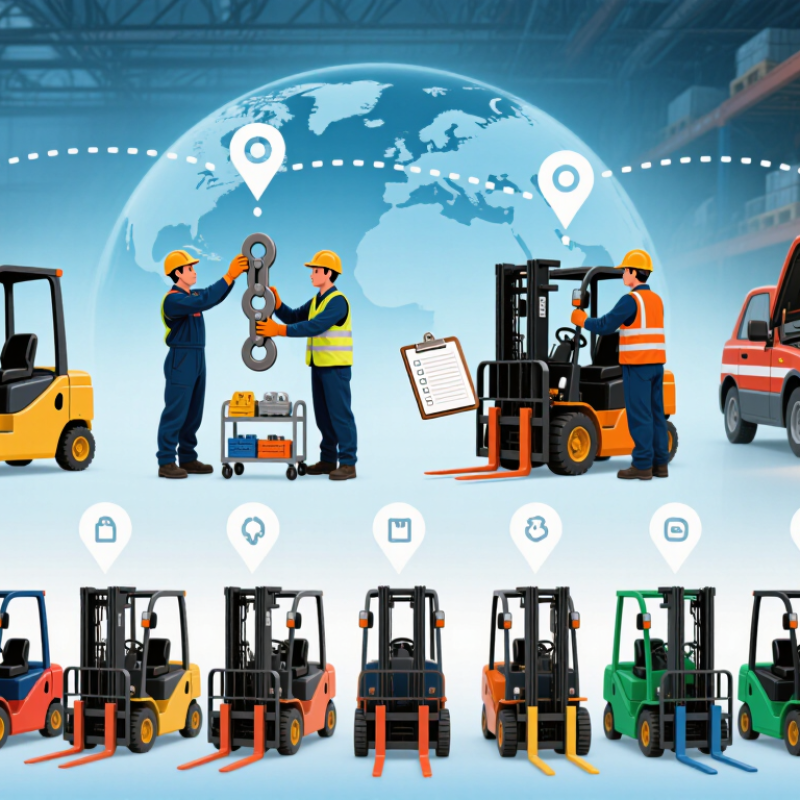
Choosing among the top 10 forklift service providers requires more than comparing hourly rates. Global buyers should examine field experience, technician certification, and service coverage in each operating region. Ask how quickly a technician can reach a warehouse after a breakdown. A clear answer matters.
Request maintenance records from similar fleets, not generic promises. Reliable providers can explain preventive schedules, inspection points, battery care, and common hydraulic faults. They should supply genuine, traceable parts and document replacement dates. Check whether technicians understand local safety rules, operator training requirements, and import procedures for critical components. Small details matter.
Look for measurable service terms. Response times, repair targets, warranty limits, and spare-parts availability should appear in writing. Remote diagnostics can reduce delays, but it cannot replace skilled on-site inspection. Ask for references from buyers operating in climates similar to yours. Dust, humidity, cold storage, and uneven floors can change maintenance needs.
Pricing deserves careful review. A low service fee may hide travel charges, overtime rates, or slow parts delivery. Compare total operating cost over three years instead of choosing the cheapest quotation. I would also test communication before signing. Send a practical fault scenario and measure the reply. Some providers appear highly professional until a simple question exposes vague procedures. That is not a minor concern; it may predict a difficult repair later.
| No. | Selection Criterion | Priority | Practical Buyer Benchmark | Evidence to Request | Recommended Evaluation Question | Main Risk if Unverified |
|---|---|---|---|---|---|---|
| 1 | Relevant Service Coverage | Critical | Documented capability for the required forklift types, including electric, internal-combustion, reach, pallet, warehouse and specialized equipment where applicable. | Service scope, technician qualification records, equipment compatibility list and completed project references. | Can the provider service our exact models, battery systems, attachments and operating applications? | Incorrect diagnosis, unsuitable parts or repeated equipment downtime. |
| 2 | Response and Repair Capacity | Critical | A documented escalation process, defined response windows and access to field technicians for urgent breakdowns. Exact times should be contractually agreed by location. | Service-level agreement, dispatch procedure, technician coverage map and historical response-time reports. | What response time is guaranteed for critical breakdowns, and how is performance measured? | Production interruption and unclear responsibility during emergencies. |
| 3 | Spare Parts Availability | Critical | Reliable sourcing for safety-critical, hydraulic, electrical, drive-system and battery-related parts, with traceability for supplied components. | Parts catalogue, stock policy, supplier traceability records, lead-time data and warranty terms. | Which frequently replaced parts are stocked locally or regionally, and what is the normal replenishment lead time? | Long repair cycles, counterfeit components or premature component failure. |
| 4 | Technician Competence | Critical | Technicians trained in mechanical, hydraulic, electrical and electronic diagnostics, with documented experience on the equipment category being supported. | Training records, certification documents, technician skill matrix and sample maintenance reports. | How are technicians trained, assessed and kept current when new control systems or battery technologies are introduced? | Unsafe repairs, recurring faults and damage to electronic control systems. |
| 5 | Preventive Maintenance Program | Critical | Maintenance schedules based on operating hours, manufacturer instructions, duty cycle, environment and equipment condition rather than calendar dates alone. | Inspection checklists, preventive-maintenance plans, condition-monitoring reports and sample service histories. | How are maintenance intervals adjusted for intensive use, dust, cold storage, corrosion or multi-shift operation? | Unexpected failures, shortened asset life and higher total operating cost. |
| 6 | Safety and Regulatory Compliance | Critical | Service procedures should align with applicable local requirements and recognized forklift safety practices, such as OSHA 29 CFR 1910.178 in the United States or EN 1175 where relevant in European applications. | Risk assessments, inspection forms, technician safety training, lockout/tagout procedures and compliance documentation. | Which safety rules apply at our operating site, and how are inspection defects documented and closed? | Operator injury, regulatory exposure, equipment damage or invalid insurance coverage. |
| 7 | Battery and Charging Expertise | Critical | Capability to inspect and maintain lead-acid, lithium-ion or other specified battery systems, including chargers, connectors, ventilation and charging controls. | Battery service procedures, charger testing records, thermal-event response plan and battery warranty conditions. | Can the provider verify battery health, charger compatibility and safe charging practices for our fleet? | Reduced operating hours, battery degradation, electrical faults or thermal safety incidents. |
| 8 | Digital Service Reporting | Important | Service records should identify the asset, operating hours, fault codes, work performed, parts used, test results, technician and follow-up actions. | Anonymized sample reports, maintenance portal demonstration, data-export format and asset-history records. | Can our team access searchable service history and export maintenance data for audits or fleet analysis? | Poor traceability, repeated repairs and difficulty proving maintenance compliance. |
| 9 | Warranty and Liability Terms | Critical | Written coverage for workmanship, replacement parts, exclusions, claim procedures and response obligations, with terms matched to the destination market. | Warranty policy, service contract, insurance certificates, claim workflow and examples of resolved claims. | What is covered if the same fault returns after repair, and who pays for labor, transport and consequential service work? | Unexpected repair costs and disputes over responsibility. |
| 10 | Total Cost and Commercial Transparency | Critical | A clear pricing model covering labor, travel, diagnostics, parts, consumables, emergency premiums, taxes, shipping and any recurring software or inspection fees. | Itemized quotation, rate card, service-level pricing, payment terms and total-cost comparison over the planned contract period. | Which charges are fixed, which are variable and how will quotation approval be handled for unplanned repairs? | Budget overruns, hidden fees and misleading comparisons between providers. |