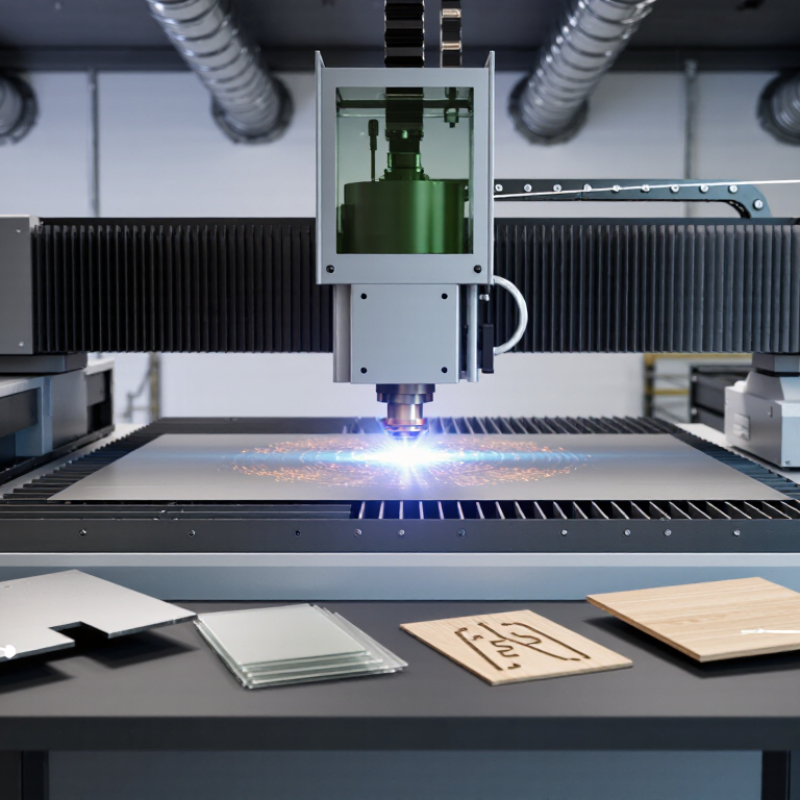
What Is an Industrial Laser Cutter? It is a computer-controlled machine that uses a concentrated laser beam to cut, engrave, or mark materials. In practical terms, an Industrial Laser Cutter turns digital drawings into precise physical parts. The beam heats a narrow cutting path until the material melts, burns, or vaporizes. Assist gas, such as oxygen or nitrogen, helps remove debris from the cut. The result is usually a clean edge with limited mechanical contact. Still, no machine is perfect.
Industrial laser cutters commonly use fiber, CO2, or diode laser sources. Fiber systems often process steel, aluminum, brass, and other reflective metals efficiently. CO2 systems remain useful for plastics, wood, acrylic, textiles, and selected nonmetallic materials. Power, lens selection, bed size, and motion accuracy affect the final result. A thick stainless-steel plate may need slower movement and carefully adjusted gas pressure. A thin acrylic sheet may require different settings entirely.
Reliable production depends on more than laser power. Operators must understand material behavior, focus position, kerf width, thermal distortion, and maintenance schedules. Safe operation also requires enclosed beam paths, ventilation, interlocks, and trained supervision. These details reflect common industrial practice, not optional decoration. In my experience, poor calibration often causes more waste than insufficient power. That observation deserves caution, because every material and machine responds differently. This guide explains the technology, major components, applications, limitations, and purchasing considerations behind industrial laser cutting. It also examines where impressive specifications can mislead buyers. The best choice is rarely the fastest machine alone. It should match the workflow, materials, tolerance requirements, and people using it every day.
What Is an Industrial Laser Cutter?
Definition and Core Purpose of an Industrial Laser Cutter
An industrial laser cutter is a computer-controlled machine that cuts, drills, or marks materials with a focused light beam. Its core purpose is to produce accurate shapes repeatedly, often from metal sheets, tubes, plastics, wood, or composites. The laser heats a tiny area until the material melts, burns, or vaporizes. A CNC system then guides the cutting head along a programmed path.
In a working factory, the process may begin with a digital drawing and a carefully selected material setting. Operators adjust power, cutting speed, gas pressure, and focus height. Small changes can affect edge quality. A clean steel edge may look smooth, while an incorrect setting can leave roughness, dross, or heat discoloration. This makes the machine highly precise, but not effortless. Good results depend on calibration, maintenance, material knowledge, and proper training.
Tips: Check the lens, nozzle, and focus before production. Use test cuts on unfamiliar materials. Do not trust default settings blindly. They may be close, but rarely perfect. Keep ventilation and protective systems active, and follow documented workplace procedures. A useful inspection includes measuring cut dimensions, checking edge condition, and reviewing waste. The technology is powerful, yet thoughtful setup still matters.
| Dimension | Definition or Typical Data | Core Purpose and Practical Relevance |
|---|---|---|
| Definition | An industrial laser cutter is a computer-controlled machine that uses a focused, high-energy laser beam to cut, engrave, or perforate materials. | It converts digital design files into precise physical components with limited mechanical contact and repeatable results. |
| Primary Cutting Process | The laser locally melts, vaporizes, or burns the material. An assist gas, such as oxygen, nitrogen, or compressed air, removes molten material from the cut zone. | This process produces narrow kerfs, clean profiles, and complex shapes without the physical cutting forces associated with many conventional tools. |
| Common Laser Sources | Fiber lasers are commonly used for metal sheet and plate cutting. CO2 lasers can process many nonmetallic materials and some metals. Solid-state and specialized laser sources serve specific production requirements. | The laser source is selected according to material type, thickness, reflectivity, required speed, and operating cost. |
| Typical Industrial Power Range | Approximately 1 kW to more than 20 kW for industrial metal-cutting systems. Lower-power systems are used for thin materials, marking, engraving, and nonmetallic work. | Higher power generally increases cutting capacity and productivity, but the appropriate level depends on material, thickness, gas selection, and process settings. |
| Typical Materials | Carbon steel, stainless steel, aluminum, copper, brass, galvanized sheet, plastics, wood, textiles, paper, and composite materials, depending on the laser type and machine configuration. | Material compatibility must be verified before processing. Some materials can release hazardous fumes or may be unsafe to cut with certain laser wavelengths. |
| Typical Metal Thickness Capability | Thin sheet metal can be cut from below 1 mm. Industrial systems may cut mild steel, stainless steel, or aluminum from several millimeters to several tens of millimeters, depending on laser power and process conditions. | Actual capacity varies with material grade, surface condition, focal configuration, assist gas, edge-quality requirements, and permissible production speed. |
| Typical Cutting Speed | From several hundred millimeters per minute to several meters per minute. Thin sheet materials can often be processed faster than thick plate. | Cutting speed affects throughput, heat input, edge quality, operating cost, and the risk of dross or incomplete penetration. |
| Positioning Accuracy | Many industrial systems provide positioning accuracy in the range of approximately ±0.01 mm to ±0.05 mm under specified operating conditions. | Accurate motion control supports tight part tolerances and consistent alignment between cutting operations. |
| Cut Kerf Width | Typically about 0.1 mm to 0.5 mm, depending on the laser type, nozzle, focal spot, material, and cutting parameters. | A narrow kerf reduces material waste and enables detailed contours, small holes, and closely nested parts. |
| Motion and Control System | Industrial machines commonly use computer numerical control, servo-driven axes, automatic height sensing, nesting software, and programmable process parameters. | Automation improves repeatability, reduces manual setup, and allows rapid production of different part geometries. |
| Work Area | Common sheet-processing tables range from approximately 1,500 × 3,000 mm to 2,000 × 6,000 mm, with larger formats available for specialized applications. | The work area determines the maximum sheet size, nesting efficiency, material-handling requirements, and floor-space needs. |
| Core Manufacturing Purpose | To cut accurate two-dimensional profiles, openings, slots, and internal features directly from digital drawings. | Industrial laser cutting is used to manufacture parts for machinery, transportation equipment, construction, electrical enclosures, appliances, and general fabrication. |
| Major Advantages | High precision, narrow kerf, low tool wear, fast design changes, reduced setup time, good repeatability, and the ability to create intricate geometries. | These benefits support flexible production, lower tooling requirements, and efficient processing of both prototypes and production batches. |
| Main Limitations | High initial investment, energy consumption, required ventilation, optical and mechanical maintenance, material reflectivity concerns, and reduced efficiency on very thick or unsuitable materials. | Production planning should consider machine capacity, safety controls, gas costs, maintenance schedules, and the total cost per part. |
| Safety Requirements | Industrial systems generally require enclosed beam paths, interlocked access panels, fume extraction, fire protection, trained operators, and procedures appropriate to the laser class and material. | Safety controls protect operators from laser radiation, hot metal, sparks, fumes, compressed gases, and high-voltage equipment. |
| Typical Output Quality | Well-configured machines can produce smooth, narrow cuts with limited burr or dross. Quality depends on material, thickness, focus, nozzle condition, power, speed, and assist-gas pressure. | Consistent process control can reduce or eliminate secondary deburring and finishing operations for many applications. |
| Best-Fit Applications | Precision sheet-metal fabrication, prototype development, short-run production, mass production, decorative panels, electrical cabinets, brackets, machine components, and customized parts. | The technology is especially valuable when designs change frequently or when complex profiles would require expensive dies or multiple machining operations. |
| Key Selection Factors | Material type, maximum thickness, sheet dimensions, required tolerance, production volume, cutting speed, automation level, assist-gas availability, software compatibility, and service requirements. | Evaluating these factors helps match the machine configuration to actual production needs rather than selecting solely by laser power. |
| Important Operating Note | Performance figures are typical industry ranges, not universal specifications. Actual results depend on machine design, material condition, process parameters, and operator practice. | A production trial and supplier-provided technical data should be used to confirm achievable thickness, tolerance, speed, and edge quality. |